

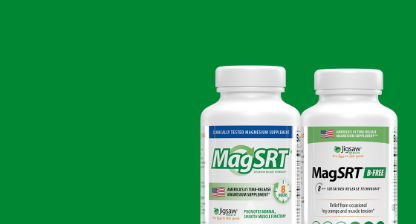





Jigsaw Magnesium w/SRT®
Support Better Sleep, Energy & Muscle Function*

✓ Support Sleep & Relaxation
✓ Relax your Legs, Muscles, & Brain
✓ The only time-release magnesium with a peer-reviewed clinical trial.




Image gallery of product variants with thumbnails and video playback option.
Jigsaw Magnesium w/SRT®
-
 MagSRT®
-
 MagSRT® (B-FREE)
 MagSRT®
 MagSRT® (B-FREE)


Supplement Facts
-
Vitamin B6 (as Pyridoxal 5-Phosphate) 5mg 294% daily value
-
Folate (as Quatrefolic® 5-Methyl Tetrahydrofolic Acid Glucosamine Salt) 200 mcg 50% daily value
-
-
Vitamin B12 (as MecobalActive® Methylcobalamin) 6 mcg 250% daily value
-
Magnesium (as Dimagnesium Malate) 500 mg 119% daily value
-
Malic Acid (as Dimagnesium Malate) 1,436 mg † daily value
††The % Daily Value (DV) is based on a 2,000 calorie diet.
†Daily Value not established.
**DFE (Dietary Folate Equivalent) is the total amount of folate per serving.
Other ingredients: Microcrystalline Cellulose, Hydroxypropyl Cellulose, Croscarmellose Sodium & Hydroxypropyl Methylcellulose (Plantbased insoluble fibers used to achieve Sustained Release Technology*); L-Leucine (Essential amino acid used as lubricant), Silicon Dioxide (Anti-caking agent), Clear Coating (Hydroxypropyl Methylcellulose and Sunflower oil) and Micro Wax (for easier swallowing).
Made with love by: Jigsaw Health, LLC. 9035 E Pima Center Pkwy, Suite 4, Scottsdale, AZ 85258
Suggested use: As a nutritional supplement, take 4 tablets per day with food. Divide doses if desired, or use as directed by your healthcare professional.


Supplement Facts
-
Magnesium (as Dimagnesium Malate) 500 mg 119% daily value
-
Malic Acid (as Dimagnesium Malate) 1436 mg † 50% daily value
-
††The % Daily Value (DV) is based on a 2,000 calorie diet.
† Daily Value not established
Other Ingredients: Microcrystalline Cellulose & Hydroxypropyl Cellulose (plant-based insoluble fibers used to achieve SRT); L-Leucine (essential amino acid used as lubricant), Croscarmellose Sodium (plant-based insoluble fiber used to achieve SRT), Silicon Dioxide (anti-caking agent), Clear Coating (hydroxypropylmethylcellulose and sunflower oil) and Micro Wax (for easier swallowing).
Suggested Use: As a nutritional supplement, take 4 tablets per day with food. Divide doses if desired, or use as directed by your healthcare professional.
Should not be used if tamper-evident seal is broken. Keep out of reach of children. Store in a cool, dry place.
Jigsaw Magnesium w/SRT®
Support Better Sleep, Energy & Muscle Function*
31k+ sold globally in last 90 days


Choose your options:

Our Quality Promise
We deliver only the highest quality nutritional supplements. Every batch of our products is triple-tested, and the 3rd party lab results are posted online for all to see. We believe that what’s on the label is what should be in the bottle, and nothing else.


MagSRT® is the only time-release magnesium supplement with a peer-reviewed clinical trial.
MagSRT® by Jigsaw Health was evaluated in the Scottsdale Magnesium Study (SMS), a placebo-controlled, human clinical trial of 91 participants. The study measured Serum Magnesium, Red Blood Cell (RBC) Magnesium, and Magnesium Deficiency symptoms. The results are published in the peer-reviewed Journal of American College of Nutrition (JACN).
Read more about the Scottsdale Magnesium Study findings...
MagSRT® is better.

What can Jigsaw Magnesium w/SRT® help me with?

Support Better Sleep, Energy & Muscle Function*

✓ Promote Energy
✓ Support Sleep & Relaxation
✓ Relax your Legs, Muscles, & Brain
✓ The only time-release magnesium with a peer-reviewed clinical trial.
MagSRT® is better.
What can Jigsaw Magnesium w/SRT® help me with?
See how MagSRT® works
See how MagSRT® works

See how MagSRT® works
See how MagSRT® works
My patients and I have all tried different brands of magnesium supplements. This product is the only one that has produced great results. After taking a break from magnesium supplementation, my patient developed leg cramps, sleep issues and then some. As soon as she resumed supplementation, all these issues resolved. So many people are magnesium deficient but have no idea. If you need magnesium this is the one you want. This brand of magnesium never produces diarrhea like other brands have done in the past. This is the best magnesium on the market! - Dr. Naja Wah
How does MagSRT compare?
|
Description |
MagSRT® |
Slow Mag® |
Mag-Tab® SR |
|---|---|---|---|
|
Amount of Magnesium per serving |
500 mg |
143 mg |
168 mg |
|
Cost of 500mg per Day |
$0.83 |
$2.08 |
$2.04 |
|
Form of Magnesium Used |
Patented DiMagnesium Malate from Albion Labs |
chloride |
l-lactate dihydrate |
|
Includes B-Vitamin Co-factors |
Yes - MagSRT / No - MagSRT (B-Free) |
No |
No |
|
Clinically Tested |
Yes |
No |
No |
|
3rd Party Label Claim Verified |
Yes |
No |
No |
How does MagSRT compare?
|
Description |
MagSRT® |
Slow Mag® |
Mag-Tab® SR |
|---|---|---|---|
|
Amount of Magnesium per serving |
500 mg |
143 mg |
168 mg |
|
Cost of 500mg per Day |
$0.83 |
$2.08 |
$2.04 |
|
Form of Magnesium Used |
Patented DiMagnesium Malate from Albion Labs |
chloride |
l-lactate dihydrate |
|
Includes B-Vitamin Co-factors |
Yes - MagSRT / No - MagSRT (B-Free) |
No |
No |
|
Clinically Tested |
Yes |
No |
No |
|
3rd Party Label Claim Verified |
Yes |
No |
No |
Supplement Facts
Jigsaw MagSRT
MagSRT B-Free
Ronald Reagan once said “trust, but verify.” Every Jigsaw Health product is triple-tested, and the lab results from an independent 3rd party have been posted below. We believe that what’s on the label is what should be in the bottle, and nothing else.
Lab Results:

This is a carousel with featured health leader reviews slides. Use buttons to navigate.
Health leaders love our nutrition products.

Ben Greenfield
Speaker & High Performance Consultant

Dr. Decker Weiss
Naturopathic Cardiologist, Founder of Scottsdale Heart Institute, Peace Possible

Dr. Emily Parke
Founder of Arizona Wellness Medicine

Dr. Keith Chambers
Founder of Chambers Clinic

Dr. Sheila Kilbane
Founder of Infinite Health

Dr. Tami Meraglia, MD
Best Selling Author of “The Hormone Secret”, CEO of US Stemology

Katie Wells
Founder of Wellness Mama

Kitty Martone - Healthy Gut Girl
Host of "Stuff Your Doctor Should Know"

Lance Dreher, PhD
Mr. Universe 1981 & 1986, Mr. America 1981, National Fitness Hall of Fame Inductee 2019

Morley Robbins, MBA, CHC
Creator of The Root Cause Protocol (RCP)

Tara Hunkin
Founder of My Child Will Thrive

Thomas DeLauer
Ketosis & Intermittent Fasting Author

Thanks for all
the
5-star
reviews!
As of January 2026, Jigsaw has
20K+
5-star reviews and an
average rating of 4.6.
| Month | Five-Star Reviews |
|---|---|
| July 2024 | 16484 |
| January 2025 | 17390 |
| July 2025 | 18202 |
| January 2026 | 20071 |
Featured Customer Reviews

We have used this supplement for years and don't plan on stopping.
My husband and I both notice a difference when using Jigsaw MagSRT. When we run out (that doesn't happen often) we can tell we are missing it. This helps with joint pain, sleep, skin, you name it. Another interesting benefit is that my husband had a thinning place in the back of his head and when he started taking this after about two months, his hair grew back in. We got off for about a month and it started thinning. It has so many noticeable benefits, that I highly recommend this for everyone. We have used this supplement for years and don't plan on stopping.
— Anonymous
Real good stuff!
Real good stuff!
— Jeffrey Reeves
Great Product!
Great Product. Started stacking on top of another type of magnesium I take after my last meal of the day & has substantially helped my ability to fall asleep & my sleep quality overall. Also love that all of your products are third party tested.
— Robert Wiesenberg
I have tried them so far so good.
— Cathelyn Atajar
First magnesium I found in 40 years that I can tolerate
First magnesium I found in 40 years that I can tolerate. It’s time released maybe that’s what makes the difference. I don’t know but totally happy I finally found something that works. ( Root Cause Protocol) was how I found you
— Louise Hendrickx
Mag SRT is definitely my “go to”
As a retired nurse I would wake up with excruciating leg and foot cramping. I’m sure in part due to dehydration, but also my Magnesium levels. I have been taking MagSRT for years now and the cramping is very rare indeed. I have my Mag RBC level in the 60s range and work to maintain that. Mag SRT is definitely my “go to” to manage this aspect and more of my life.
— Kurt Ruga
Really happy with my experience
Jigsaw has been an amazing resource for me! I feel confident about the quality and see the results everyday (specifically with the Mag-SRT). Customer service is tremendous, which is always a HUGE plus and something I look for in companies. Really happy with my experience over several years with them :).
— Bethany Myers
key ingredients to my health
I have used Jigsaw products with timed release, including B and Magnesium, for over a decade. They are key ingredients to my health.
— William Rothe
So happy with this product!
Ive taken magnesium on an off over the years to help with anxiety like issues. After having my second baby, my muscles were constantly twitching and my BP has been all over the place. I’ve also had stomach and skin issues for about 10 years. While I have been prescribed medication, I have noticed a huge difference taking this magnesium over the other OTC ones I’ve found in stores. The muscle twitches calmed and my stomach seemed better. The jury is still out on the skin issues. I was also less tired during the day. I’ve been without if for about 2 weeks, tried another one I found in store that had similar ingredients...and it’s just not the same. Muscles are twitchy again, stomach is out of sorts, and I’m just sore and tired. I just ordered the MagSRT with B in it and hope for even better results. So happy with this product and don’t mind spending the money!
— Joy Weatherman
love the product
Love them, love the product, even my grandma can feel the difference with more magnesium
— Elmer Servellon
benefits of magnesium
I found the benefits of magnesium and the root cause protocol for a couple of years now. Since I starting using this product I have felt a lot more energy throughout my day and have been sleeping better. This is a great way to get the Magnesium I need.
— Tyson Brown
87 years old, no meds & feeling GREAT!
This product has literally saved my life!!! Started using it about six years ago and don't ever want to be with out it. No doctor was ever able to help me with my digestion and colon problem. I've sent others to Jigsaw because of MagSRT! I'll be ordering again soon. Eighty seven years old, no meds and feeling great. Thank you Jigsaw!
— Jean Sutton
I've been taking MagSRT for years!
I have been using MagSRT for several years now and it makes a difference in my pain relief and bowel movements. I will keep taking it from now on.
— Don Cox
Excellent Product!
Excellent product. I am 84 years old and walk 3 miles every morning. I used to get terrible leg cramps at night. I take 2 tablets (1 morning, 1 evening) of your product and it has helped a lot!
— Kent Folgate
Happy customer of 10 years!
I have been a Jigsaw customer for around 10 years. I take 2 tablets before bed nightly and I enjoy a comfortable sleep, usually without interruption. It is easy to order with prompt delivery!
— Sandra Buchanan
Love Jigsaw Products!
MagSRT certainly lessens my leg cramping and helps me stay on the courts longer! Love all the Jigsaw products I’ve tried so far!!
— Julie Scott
Helps my leg cramps!
I use Magnesium because I have leg cramps during the night. MagSRT is the only product I have found that alleviates the problem, at least 80 to 90 percent of the time for an extended period of time. When it doesn't I have the Ancient Minerals magnesium lotion Jigsaw sells. I don't know how that works, but when I am in the grip of painful leg cramps in the middle of the night I use it on the cramps and it works.
— Allan Page
We love this product!
We have been buying this product from your company for several years. Both my wife and I take it on a regular schedule. We order it when we need a new supply. The thing I like about your company is we are not constantly bombarded with all kinds and forms of advertising. We are elderly folks in our mid 80’s and this seems to be a beneficial product for us.
— Jerome Harting
I get to keep doing what I love, because of MagSRT!
I am a serious gardener and as i was starting to have some difficulties with my knees (all the ups and downs required working daily in my garden I was concerned about how long I could continue doing what I love most of all). A good friend suggested Jigsaw Magnesium and sent me a bottle. I tried it out and within a month noticed a difference (without the obvious side effects that other similar brands had) All I know is that was more than 10 years ago, and I never think about those concerns anymore. I have stopped taking Jigsaw Magnesium for periods of up to 3 months to see if I could notice a difference and sure enough, once I started back again, i could see that i was deficient in magnesium and needed your product. I also noticed a marked improvement in nails and hair and skin! I am 77 years old and I vote for anything that can keep this body strong and resilient. Thanks so much for your excellent service and your great sense of humor.
— Wendy Wray
Great Magnesium!
These Magnesium supplements work great, especially if you practice intermittent fasting. Magnesium is very critical during a fast!
— Michelle Reed
Jigsaw offers the BEST high quality supplements!
I appreciate the high quality supplements Jigsaw offers. The magnesium SRT has high efficacy without side effects. The tablet dosage allows for gradually increasing magnesium as tolerated. The Adrenal Cocktail is a convenient way to supplement whole food ACs as needed. The website wasn’t as user friendly as I’d hoped, but customer service was AWESOME! When I got too many bottles of AC and not enough magSRT, Jonathan sent me the desired qty of magSRT and a label to return excess sealed bottles of AC. He also adjusted my automatic renewal order so it was exactly what I wanted. Great products. Spectacular customer service🙂
— E. Vrchota
Great Products and Customer Service!
I've been using MagSRT and Electrolyte Supreme for years. Started playing pickleball two years ago and find the electrolyte mix keeps me hydrated especially during the Arizona desert heat. Also, like the professional staff who truly do act like their customers are their friends. Well done Jigsaw!!!
— Tom Blondi
I am so amazed how the Jigsaw product, Magnesium SRT
I am so amazed how the Jigsaw product, Magnesium SRT worked for me, literally overnight. Several years ago, I was plagued with terrible head tension and my husband said he had read about this product and suggested that I try it. I really didn’t think it would work at all but at the time, I didn’t have anything to lose. I may skip my other supplements once in a while, but I never skip my Magnesium. It really did help me.
— Debbie Edmondson
Magnesium SRT
This has been a real answer to prayer for me. I had suffered for many years with terrible leg cramps. I had tried many different things to get rid of the cramps without any success. After taking Magnesium SRT for a week or two the cramps finally stopped. I have been taking this for several years now with only a very rare cramp. This supplement has drastically improved my ability to sleep without cramps.
— Mary
Superior Magnesium Supplement
My patients and I have all tried different brands of magnesium supplements. This product is the only one that has produced great results. After taking a break from magnesium supplementation, my patient developed leg cramps, sleep issues and then some. As soon as she resumed supplementation, all these issues resolved. So many people are magnesium deficient but have no idea. If you need magnesium this is the one you want. This brand of magnesium never produces diarrhea like other brands have done in the past. This is the best magnesium on the market!
— Dr. Naja Wah
My favorite supplement
This one is easy on my stomach, helps me recover from working out, and helps with pain and stiffness in my joints.
— Jennifer
MagSRT is a lifesaver for me!
Hello, Friends! My name is Deb Vangellow. I am an LPGA Master Golf Professional in Houston, Texas. I want to take this opportunity to thank Patrick and the fantastic team at Jigsaw Health for their WONDERFUL product line. I am definitely a loyal fan! JigsawHealth offers an excellent line of vitamins and supplements. The one that I simply cannot do without is their timed release Magnesium…what a lifesaver for me! I know the huge total wellness benefits that magnesium plays in the body and how important this supplement is. I have been using the Jigsaw Health MagSRT for a few years and have never felt better. The increased energy and decreased muscle cramps cemented my decision…this is the product that has made the biggest positive change for me working in the Texas heat! Thank you for your continued support, Patrick and Jigsaw Health! I am grateful to you all and for your fine products! It is FUN to FEEL good!
— Deb Vangellow
Amazing People delivering an Amazing Product
Owning and operating a Gracie Jiu-Jitsu school and being a Functional Medicine Certified Health Coach, I have seen and taken many supplements over the years. Everyone I have referred this product to has been impressed and amazed by the quality and positive impact it has made for them. If you ever have the opportunity to meet the people that are delivering this product to the market you will be impressed and amazed by the quality of their character and the positive impact they make on those around them! Jigsaw Health is a stand up company that is owned and operated by stand up people (something that seems to be harder and harder to find in business today). We all have a choice in what we choose to purchase and why we choose to purchase. I choose to research to find the best, and buy from the best. I believe that where and to whom our money goes is an important factor in making purchases in any field. When it comes to my health and the supplements I personally take and recommend, I want the absolute best, purest, and scientifically backed products on the market. I also want my money to go to companies and people that I believe have a strong ethical and moral guidance. If these ideas are important to you as well, look no further and order your Jigsaw MagSRT (and without hesitation) any of the Jigsaw line of products today!
— Adam
MagnesiumSRT
I’ve been taking this for many years, initially for leg cramps, then for heart health. My quality of life would suffer if I had to do without this product.
— Evelyn Lowery
What a difference!
So I have been taking MagSRT for about 3 weeks now and wow what a difference it has made. I sleep so much better, am happier, and am more resilient. That stuff is good! I’ve use other magnesium supplements before but none are as good as your stuff
— Hayden D
THIS IS THE ONLY MAGNESIUM PRODUCT THAT WORKS!
I have been taking this for years. Prior to that I had extreme cramping in my shoulders, muscle burning which was followed by extreme skin sensitivity. Doctors tested me for everything. All tests were negative. I started MagSRT and all issues have resolved and have been gone for years now. We all should be taking this supplement. Thank you Jigsaw Health for making this great product!
— Carla Odetto
Review of MagSRT
I buy the MagSRT from Jigsaw and find that it is a great product. Not only does it help my husband and I with intestinal health, but I find if I forget to take it a day or two, my legs just ache at night when I go to sleep, and I wake often from the pain. I know that every cell in your body needs magnesium, and for heart health as well as bone health. I will never stop buying this product for myself and my husband! 5 Thumbs Up on this product !
— Julie John
Relax
ALL other magnesium supplements gave me stomach issues so bad, but I decided to try this and I LOVE it! Better sleep too!
— Jane
FAQs
Jigsaw Magnesium w/SRT®
90-Day, No-Hassle, Money Back Guarantee
We love our products and we believe you will too. However, if you are not completely satisfied, please contact us within 90 days and we will gladly refund 100% of your purchase.


